
The Anatomy of the Transit
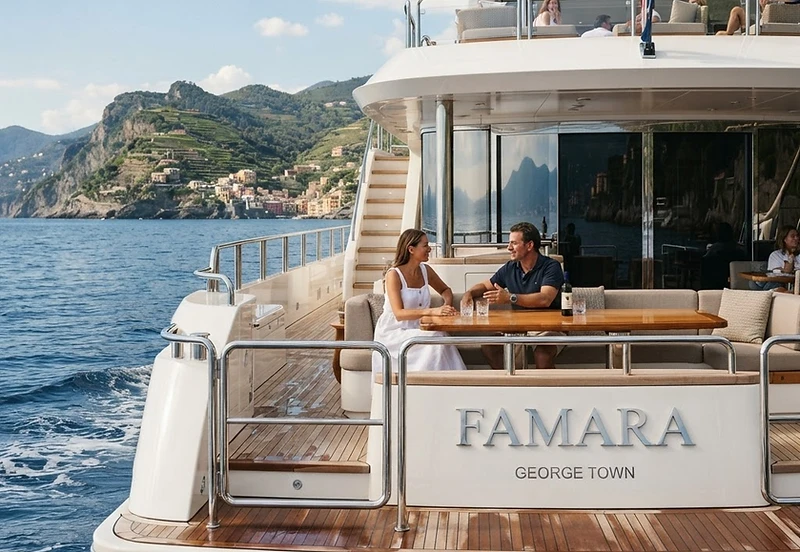
To cross the Ligurian Sea is to surrender one’s perception of static time. As the coastline of the Riviera slips into a haze of pale violet, the superyacht ceases to be a mere vessel and becomes a localized climate, a pressurized bubble of teak and brushed steel suspended above five thousand feet of abyssal blue. The sensation is one of profound, synthetic isolation; while the engines hum with a low-frequency vibration that barely troubles the crystal stemware in the galley, the world outside is reduced to a series of shifting, monochromatic gradients. It is precisely three in the afternoon when the Captain clears the last of the shipping lanes near the Gulf of Genoa, and the yacht, a custom 45-meter Perini Navi, finds its rhythm. The air here is cold, sharpened by the proximity of the Alps, even as the sun glares with deceptive Mediterranean warmth.
There is a specific discipline required to inhabit this space during a crossing. One must reconcile the grandeur of the interior—with its curated walnut veneers and the cool tactility of hand-stitched leather—with the sheer, unblinking indifference of the open sea. The horizon acts as a stern arbiter, stripping away the decorative noise of the shore until only the structural essence of the hull remains. Sitting in the main salon, watching a single silver serving tray remain perfectly stationary as the vessel slices through a two-meter chop, one realizes that luxury here is measured in the absence of movement. It is a quietude born of weightless velocity, a paradox that only manifests when the land has fully retreated from view.
Surface Tension and Engineered Calm
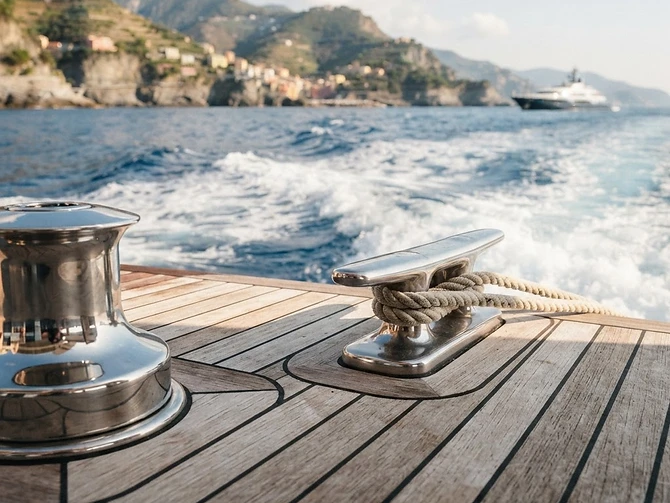
On the aft deck, the architecture of the yacht reveals its intended purpose: to exert absolute order upon the fluid. The stabilizers, humming with an almost imperceptible hydraulic intelligence, ensure that the water in a glass remains undisturbed by the rhythmic rise of the swell. It is a triumph of engineering that feels almost ghostly in its execution, a soft mechanical sigh that persists for hours. One spends the afternoon watching the wake, a churning white ribbon of geometry that mirrors the vessel’s passage before dissolving back into the deep cobalt depths. It is an ephemeral art, the sculpture of a transit that leaves no scar, only a brief, necessary interruption in the continuity of the current.
The true luxury of the sea is not the proximity to the coast, but the deliberate erasure of it.
At four o’clock, the chef emerges to offer a simple bowl of chilled cucumber and mint soup, the bowl resting on a linen napkin that feels heavy and grounded against the constant, vibrating hum of the engine room below. There is a singular pleasure in this isolation; the ship’s radar shows no traffic for thirty miles in any direction. The sky begins to shift from a high-noon brilliance to a bruised, heavy gold, and the yacht’s exterior lights flicker to life, casting a warm, amber glow against the stainless steel railings. One does not speak much during these hours; the sea commands a reticence, a meditative state where the only necessary task is to watch the water change texture as the wind shifts from the north.
Arrival as an Afterthought
As the light wanes, the atmosphere takes on a metallic, brittle quality, signaling the approach of the northern reaches. The transition from the deep, oceanic abyss back toward the shallow, sun-warmed bays of the coast is, quite frankly, jarring. The cabin’s climate controls begin to lose their battle against the scent of pine and wild rosemary drifting from the encroaching shore of the Italian coast. We draw closer to the harbor at Portofino, the distant silhouette of the village beginning to assert its presence against the darkening cliffs. It is a sudden return to gravity.
One finds that the destination—a slip in a port or a buoy anchored off the coast—is ultimately less satisfying than the liminal space left behind. To have crossed the Ligurian is to have occupied a state of suspension, a brief residency in a world defined not by the concerns of land, but by the relentless, beautiful persistence of the tide. As we slow to navigate the entrance, the engines drop their pitch to a low, melodic thrum, and the reality of the harbor—the small boats, the dock hands, the lights reflecting on the black water—feels like an intrusion upon a dream of perfect, frictionless flight.






