
The Architecture of the Unmoving Table
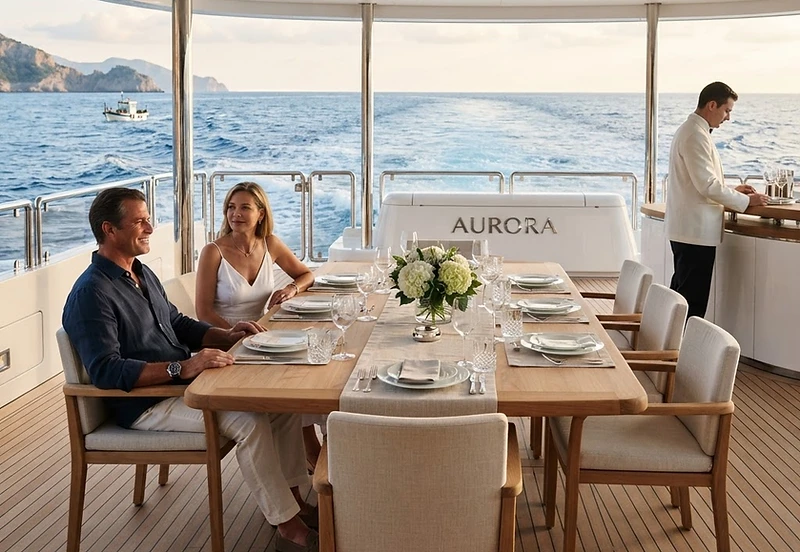
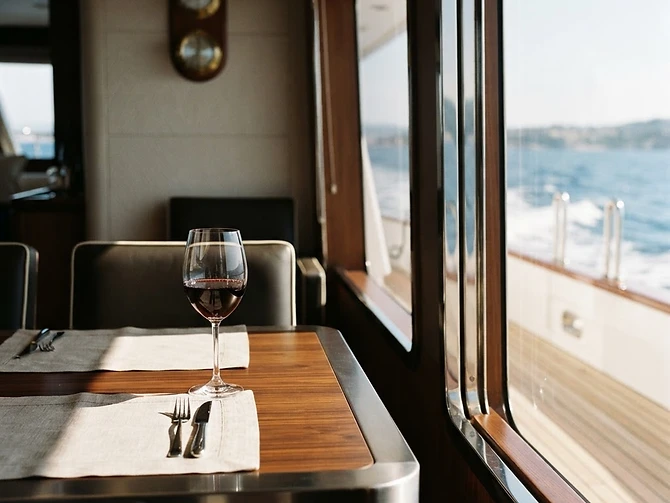
To dine at sea for twelve is to engage in a quiet defiance of the ocean’s inherent instability. Within the dining saloon of a sixty-meter vessel, such as those crafted by the masters at Feadship or Abeking & Rasmussen, the interior architecture must do more than merely please the eye; it must anchor the guest against the subtle, rhythmic roll of the hull. The table, often a monolith of bespoke macassar ebony or polished white onyx, is not merely a piece of furniture but a foundational element of the yacht’s interior program. It is the vessel’s central pivot, a place where the grandeur of social convention meets the cold, computational reality of gyroscopic stabilizers that hum below the floorboards.
Great care is taken in the material selection to ensure that the setting feels grounded rather than fragile. Leather-wrapped seat frames and high-friction textiles are chosen not only for their aesthetic grace but for their tactile reliability. I recall one evening anchored off the rugged coast of Corsica, where the swell was persistent but barely felt. The dining saloon became a sanctuary of near-absolute stillness. The lighting, an art form of its own, was composed of recessed apertures that mimicked a soft, perpetual twilight, ensuring that the crystalline stems and heavy silver caught no erratic glare from the shifting water outside. It was a space that effectively ignored the horizon, focusing instead on the shared intensity of the moment.
The Choreography of the Service
Beyond the physical structure lies the silent rhythm of the crew, a staff whose movements must be as fluid as the currents beneath the keel. Serving twelve guests in a space that, while expansive, remains a contained environment, requires a choreography of extraordinary restraint. There is no room for the clumsy or the loud. Plates are presented with a measured elegance, timed to the vessel’s breathing, ensuring that a sudden wake or a shifting tide never interrupts the delicate work of the galley.
The dining room is not just a place to feed, but an altar to the act of arrival. When the anchor drops in a place as remote as the Kornati islands, the salon transforms from a transit space into a fixed, quiet point in the vastness of the archipelago.
The ritual of the meal is a tether, grounding those aboard to a human timeline that exists independent of the ship’s passage. I remember the scent of sea salt mixing with the faint aroma of roasting sea bass, seasoned with herbs gathered from the nearby shore earlier that afternoon. Throughout the service, the sea remains a silent, dark presence beyond the floor-to-ceiling glass. It serves as a reminder of the miles already covered and those left to go, yet inside, the atmosphere is calibrated for intimacy. Here, twelve individuals find a moment of stillness that is rare even on land, achieved through the seamless integration of maritime engineering and the disciplined art of professional service.
The Heart of the Voyage
As the evening deepens and the engine’s soft thrum fades into the absolute silence of the anchorage, the dining saloon remains the heart of the vessel. It is here that the day’s exploration—whether of regatta marks in the Mediterranean or hidden, crystalline coves off the coast of Montenegro—is finally distilled into conversation. One can almost hear the soft clink of cutlery against porcelain acting as a metronome for the evening. In these hours, the outside world feels remarkably distant, rendered irrelevant by the deliberate luxury of the room. It is a preservation of human warmth against the backdrop of an indifferent and infinite sea, a testament to the belief that even in the middle of a vast, moving ocean, one can build a perfectly still center.
Ultimately, the dining saloon serves as the vessel's soul, proving that the luxury of yachting is not found in the speed of the transit, but in the quality of the stillness one can construct at the day's end. As the last course concludes, there is a profound satisfaction in knowing that while the world moves on, the table remains—a bastion of order, grace, and connection amidst the deep, dark blue.






