
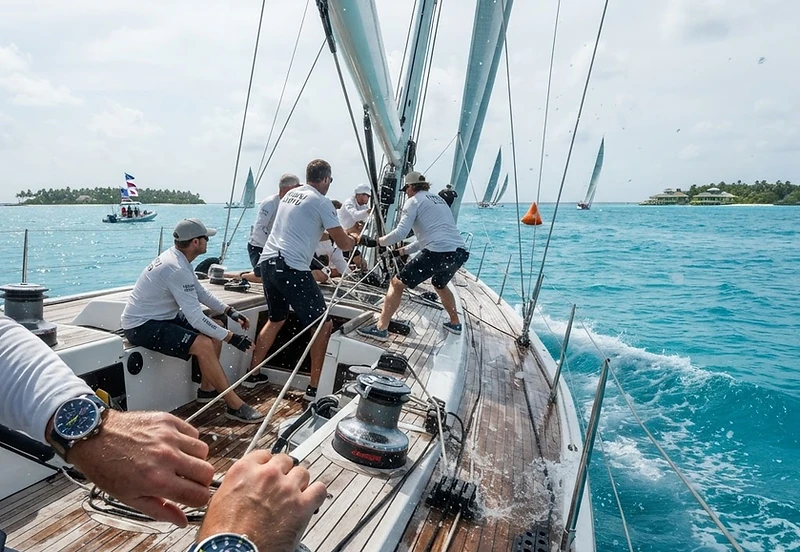
The morning light in the Baa Atoll does not so much break as it dissolves, turning the sky from a bruised indigo to a pale, translucent celadon. We are anchored near the edge of a deep-water channel, the Nautor’s Swan 98 riding the gentle swell with the effortless grace of a seabird. Ahead, the fleet gathers. The water here is unnervingly clear, revealing the jagged architecture of the coral reef far below, a silent, submerged cathedral that dictates our every tack. There is a weightlessness to the atmosphere, as if the air itself were composed of salt and expectation, waiting for the first breeze to stir the doldrums of the dawn.
The Synchronization of Seconds
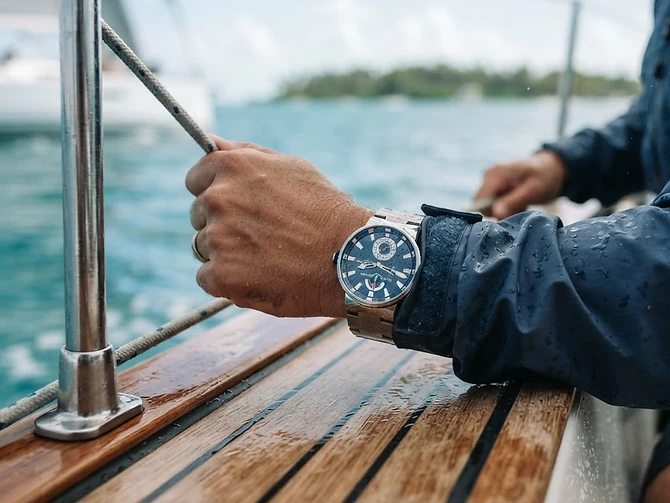
Before the starting gun, there is the watch. On my wrist, the Ulysse Nardin Marine Regatta acts as the nervous system of the morning. There is a distinct, tactile pleasure in the countdown; the mechanical sweep of the hand tracing backward from ten minutes feels like the very pulse of the yacht itself. As the first horn sounds across the water, the crew moves with a synchronized intensity, the smell of damp salt mingling with the faint, metallic scent of the winches. We are not just racing; we are calibrating our vessel against the relentless, shifting currents of the Maldives. Each adjustment is a negotiation with physics, a testament to the fact that while the ocean is vast, the margin for error is razor-thin.
The Line and the Reef
The starting line is marked by two buoys bobbing in the relentless heat, a fragile threshold between the open expanse and the sheltered shallows. As we cross, the boat heels hard to starboard, the deck tilted at an aggressive, exhilarating angle that forces a sudden, acute awareness of one’s own gravity. I recall the sharpness of an espresso enjoyed barely an hour earlier at the Soneva Fushi jetty—a bitter, grounding contrast to the crystalline, fluid chaos we now occupy. That quiet moment on the weathered timber of the dock, listening to the gentle lap of the lagoon against the pilings, feels a world away from the adrenaline that now commands the cockpit.
The wind here is a fickle companion, funneled between atolls, requiring constant and nuanced adjustment of the mainsail. To be at the helm is to surrender to the geometry of the sea, balancing the wind’s velocity against the drag of the hull, every movement echoing the precision of the chronograph that governs our tactical life. We move through the channel with a predatory focus, the carbon-fiber hull slicing through the turquoise water, leaving a fleeting wake that vanishes almost as quickly as it is carved.
Beyond the Horizon
As the fleet pulls away, the distant roar of the outboards from the spectator tenders fades, leaving only the hypnotic sound of water rushing past the keel. There is a profound, quiet elegance in this speed—a marriage of modern engineering and the ancient, indifferent rhythm of the Indian Ocean. We drive toward the horizon, the watch ticking toward a victory measured not just in seconds, but in the seamless alignment of wind, tide, and mechanical intent. Here, on the deck of the Swan 98, the world narrows to the tension of the lines, the pressure of the tiller, and the singular, silent beauty of the blue.
As the sun climbs higher, bleaching the color from the sky and turning the sea into a sheet of hammered silver, we hold our course. The regatta is a fever, but the yachting life remains a meditation. When the final buoy is rounded and the sails are finally eased, there will be the quiet satisfaction of a well-executed passage and the cooling promise of the deep atoll waters, far from the reach of the shore.






