
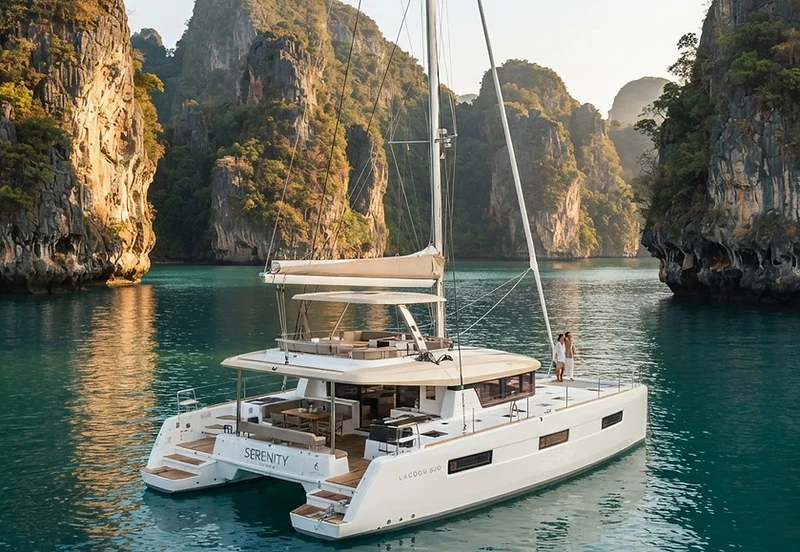
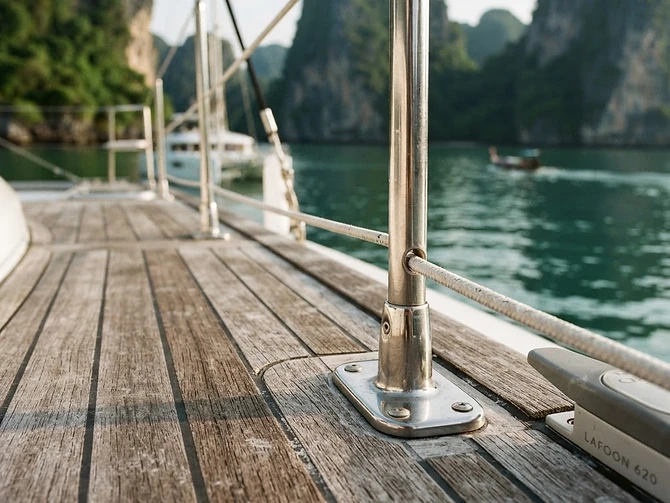
The Andaman Sea does not merely reflect the sky; it absorbs the emerald density of the karst towers that define Phang Nga Bay. Stepping aboard our Lagoon 620, a catamaran whose dual-hull geometry provides a stable, sprawling platform, felt less like boarding a vessel and more like inhabiting a floating pavilion. The wide beam allowed for a sense of interior volume that is rare in monohulls, with the saloon and aft deck functioning as a single, seamless terrace designed for the horizontal life of the tropics. Here, the boundary between the teak-laid deck and the mirror-flat water is perpetually blurred, inviting one to participate in the slow, liquid cadence of Southeast Asian cruising.
The Geometry of the Anchorage
Our days were punctuated by the rhythmic pull of the tide against the anchor chain, a tactile reminder of the forces governing these limestone cathedrals. One morning, anchored in the sheltered lee of Koh Hong, the silence was profound, broken only by the gentle, percussive lapping of water against the hulls. I spent the early hours on the foredeck, watching the mist evaporate from the jagged, moss-covered peaks that seemed to hang suspended above the sea. The sheer verticality of these geological sentinels creates a unique microclimate of shadow and light, where the air remains cool long after the sun has breached the horizon. It is a place that demands a certain stillness; the movement of the yacht is not a means to an end, but a deliberate negotiation with the geography of the islands.
Navigating these waters requires a captain’s intuition. The Lagoon 620 thrives here, its shallow draft offering an intimacy with the shoreline that larger, deeper-keeled vessels simply cannot replicate. We spent a morning threading the tender through narrow, hidden passages between the towers, eventually emerging into a secluded blue lagoon accessible only at high tide. There is an undeniable thrill in knowing that your vessel is the only point of civilization within miles, a tiny, self-contained universe of comfort amidst the raw, prehistoric scale of the Andaman.
Reflections on the Aft Deck
Life aboard a crewed charter in these waters is a study in restrained transitions. By midday, the humidity becomes a physical presence, tempered only by the constant breeze moving through the open-air saloon. Lunch was a masterclass in local sourcing: fresh snapper grilled with lemongrass and bird’s eye chili, served with a side of jasmine rice that seemed to taste better under the salt-heavy air. As the sun dipped behind the limestone horizon, the light fractured in a way that mimicked the gold-hued lacquer of the traditional long-tail boats that occasionally dotted the distance. We sat on the aft deck, watching the sky shift from pale citrus to a bruised, heavy purple, the heat of the day finally giving way to the velvet approach of night.
As darkness took hold, the crew began the ritual of setting the anchor light—a small, steady beacon against the profound, ink-black void of the Andaman. There is a peculiar comfort in being so definitively tethered to the seabed while the current moves steadily beneath the cabin floorboards. We were not simply passing through these waters; we were participating in the slow, geological shift of the islands, mediated by the luxury of a vessel that understood the necessity of both stillness and speed. Lying in the aft cockpit as the stars emerged, the water beneath us alive with a faint, bioluminescent glow, the true luxury of the yachting life became clear: the ability to find a home within the wild, protected by nothing more than a few inches of fiberglass and the quiet confidence of a well-found ship.
The voyage through Phang Nga Bay remains one of the few experiences that manages to humble the traveler while simultaneously elevating the standards of their comfort. To exist between the limestone pillars is to exist in a state of suspended animation, where the only clock that matters is the tide, and the only destination is the next quiet stretch of turquoise water.






