
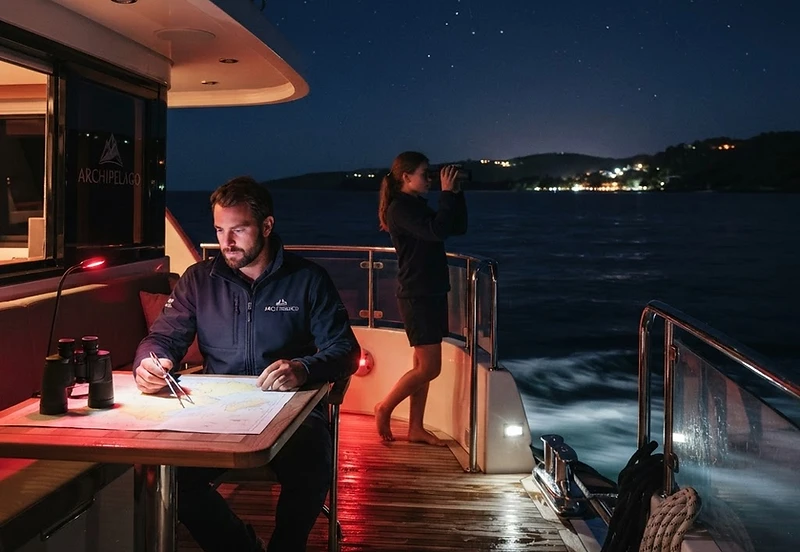

The deck of our Nautor's Swan 90 is an expanse of warm, scrubbed teak that seems to hold the day's heat long after the sun has slipped below the horizon. We are hovering near the Mnemba Atoll, the Indian Ocean a black, liquid void beneath our hull. There is a specific kind of silence that descends when the sails are trimmed and the ship is left to the rhythm of the swell; it is a silence composed of the faint creak of rigging and the occasional, rhythmic lap of water against the fiberglass underbody. In this space, the vessel feels less like a machine and more like a living organism, breathing in sync with the current.
The Geometry of the Night Watch
Stepping onto the bridge at 02:00, the cockpit feels like an architectural extension of the sea itself. The low-profile coamings offer shelter, turning the helming station into a private terrace that moves through the dark. I find my hand resting on the carbon-fiber wheel, feeling the tension of the rudder as we maintain a steady heading. To the south, the constellation Crux—the Southern Cross—hangs with a clarity that renders the star charts redundant. The air here is heavy with salt and the faint, sweet scent of cloves drifting from the distant Zanzibar spice plantations. Being two hundred miles from the familiar bustle of Stone Town provides a peculiar clarity; the darkness is absolute, save for the navigation lights and the bioluminescence that flares like underwater lightning in our wake.
A Symphony of Salt and Stillness
Before the watch rotation, we had gathered in the saloon, where the interior woodwork—satin-finished mahogany—glowed softly under low-voltage recessed lighting. The transition from the air-conditioned cabin to the humid, open-air cockpit is always a shock to the senses. Out here, the scale of the world shifts. We did not speak much; the sea does not demand conversation, and on a vessel of this caliber, the quiet is a testament to the crew's discipline. Instead, we observed the way the masthead light illuminated the fine mist of the Indian Ocean air, turning the bowsprit into a phantom arrow pointing toward the mainland of Tanzania.
We spent the late evening anchored in the lee of the atoll, watching the tide retreat. The water here is so shallow in places that one can see the white sand reflected in the starlight. Tomorrow, we will deploy the tender and make for the reefs, but tonight belongs to the passage. There is a profound elegance in this isolation—the way the architecture of the yacht, all curves and tension, holds us safely between the stars above and the deep, unexplored trenches of the Zanzibar Channel below.
The Transition Toward Dawn
As the night wears on, the fatigue begins to take on a pleasant, weighted quality. The ship is a sanctuary, a finely tuned instrument of navigation that hums with the energy of our journey. The vastness of the ocean requires a certain humility; you realize that you are merely a transient guest in these waters, passing through a corridor used by dhows for centuries. We are stewards of this time, waiting for the first grey light to bleed into the horizon near Nungwi, where the morning ritual of espresso and the inevitable, shifting tides will begin again. As the sky turns from charcoal to indigo, the Southern Cross begins to lose its dominance, surrendering the heavens to the returning sun.
The return of light brings with it the reality of our destination. By breakfast, the crew will be preparing the deck, checking the running rigging, and plotting the approach into the harbor. For now, however, we remain suspended in the stillness, holding our place in the immense, dark rhythm of the Indian Ocean.






