
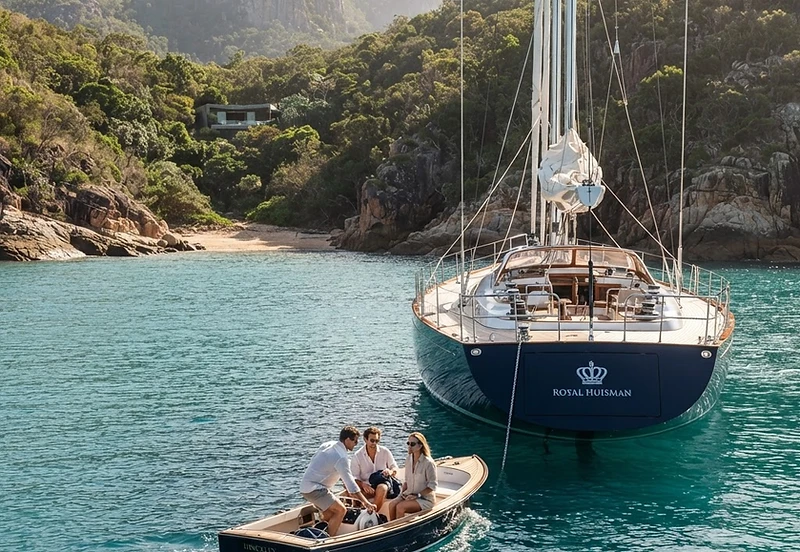
The morning off the coast of Whitsunday Island began with the rhythmic, hypnotic slap of water against the plumb bow of our Royal Huisman ketch. We were anchored in a secluded, unnamed bight, the hull a brilliant, stark white against the deep, saturated teal of the Coral Sea. From the bridge, the shoreline appeared initially as a singular, impenetrable mass—a steep, verdant rise of native hoop pines and weathered, ancient granite. It was only after a few minutes of study through the Steiner binoculars that the clean, modernist lines of a private stone villa emerged, cantilevered daringly over the drop-off, appearing to defy the gravity of the cliffside itself.
The Tender to the Precipice
Stepping off the yacht and into the custom Hinckley tender, the transition was visceral. The air, heavy with the sharp, resinous scent of salt and eucalyptus, shifted significantly as we approached the cliff base. Navigation in these waters demands a steady hand and an intuition for the currents; the tides in the Whitsundays move with surprising, muscular vigor, pulling at the hull with a strength that belies the calm surface. As we approached the private jetty—a narrow, hand-carved sliver of stone set directly into the rock face—the scale of the coastline became clear. There is a distinct, grounding architecture to this part of the coast: a raw, geological brutalism where structures are not merely built upon the land, but rather folded into its harsh, ancient geometry. One feels like a temporary guest of the island’s tectonic history.
Ascent and the Southern Meridian
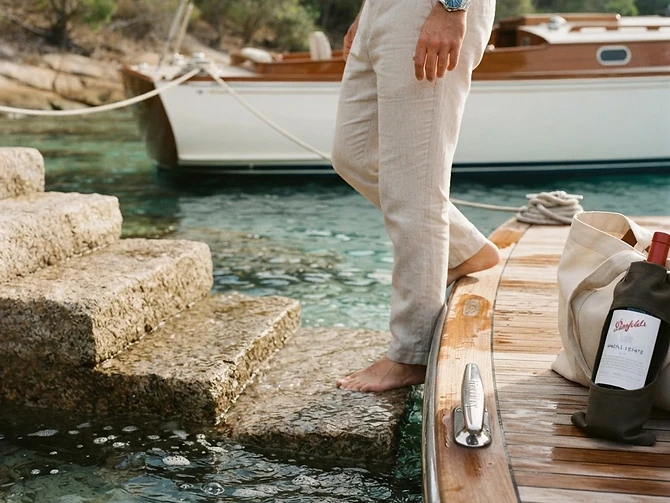
The ascent via the granite stairs was a slow, deliberate exercise. Each step was cut directly into the living rock, slick with the spray of the morning swell. Reaching the terrace, the breath is held not just by the exertion, but by the sheer, sweeping aperture of the view. Looking back toward the yacht, the perspective shifted entirely; our Royal Huisman appeared as a singular, gleaming artifact floating in a vast, liquid expanse of sapphire. It is a humbling sensation to stand on solid ground and see your own vessel anchored in the void, a small, independent ecosystem of teak and rigging against the overwhelming breadth of the Pacific.
We were greeted on the terrace by the silent, efficient presence of the villa staff, who offered us fresh citrus and chilled water. There, suspended between the canopy of the pines and the churning reef below, time seemed to decelerate. We spent the better part of the afternoon observing the play of light across the shoals. The water is so clear that from the height of the villa, one could track the shadows of eagle rays navigating the coral gardens twenty feet below. It was an afternoon defined by a profound, quiet luxury—the absence of engine noise, the absence of schedule, and the presence of the trade winds rattling the palm fronds.
The Gravity of Arrival
As the sun began to dip, casting long, bruised violet shadows across the water, we watched our crew ready the tender for our return. The boat, a tiny white pulse in the sprawling, indifferent blue of the reef, signaled that our time in this isolated sanctuary was coming to a close. There is a specific, fleeting satisfaction in such arrivals—that rare, quiet moment when you realize you have navigated to the very edge of the map. As we descended the stairs to the jetty, the cooling granite under our feet and the encroaching dusk reminded us that we were merely passing through. We left the island as we found it: silent, imposing, and perfectly indifferent to our visit, leaving us with nothing but the memory of the salt on our skin and the sight of our own mast leaning ever so slightly against the horizon.






