
The Quiet Approach to Merchant Row
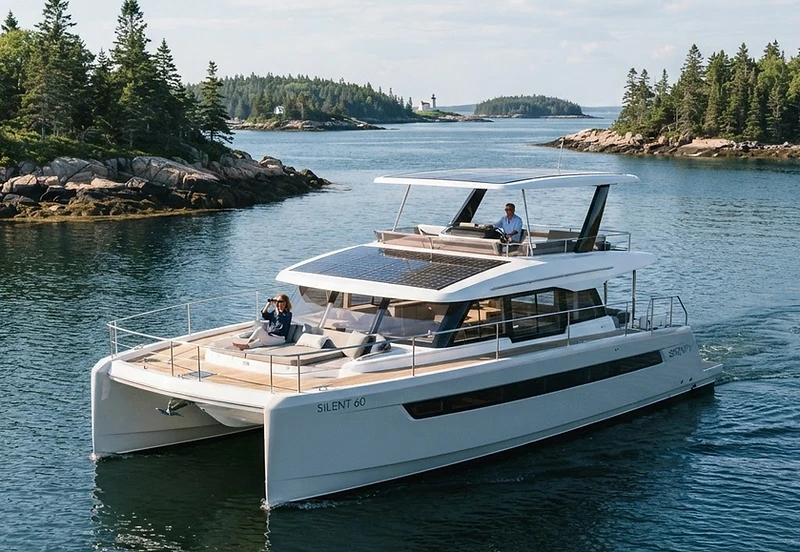
The dawn off the coast of Stonington arrived with a distinct, cool clarity that only Maine in September can sustain. We were aboard a Silent 60, its solar array absorbing the low-angled morning light with an efficiency that felt entirely at odds with the traditional roar of a twin-diesel cruiser. As we navigated the intricate channel of Merchant Row, the lack of vibration was startling. There was only the gentle slap of water against the twin hulls and the occasional cry of an osprey circling the spruce-clad islets. Here, in the heart of the Maine Coastal Islands National Wildlife Refuge, the absence of engine noise allowed us to hear the environment in a way that felt almost illicit, as if we were intruding on a private conversation between the tide and the granite.
Rhythms of the Aft Deck
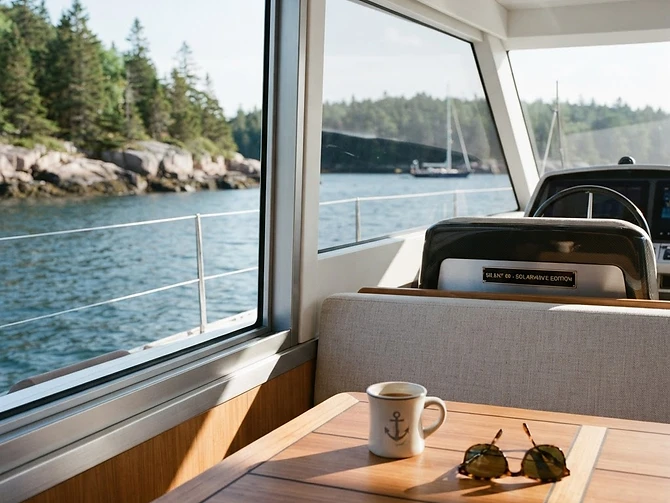
Life aboard a vessel with such a restrained, carbon-neutral footprint naturally dictates a different cadence. By mid-morning, as we tucked into the sheltered anchorage near Isle au Haut, the ritual of the cruise took center stage. We breakfasted on the teak aft deck, the table set with ceramic bowls of wild Maine blueberries and thick-cut sourdough from a bakery in Camden. There is a particular intimacy in dining at anchor when the boat remains silent; the clink of cutlery and the quiet hum of the induction galley are the only markers of time. The crew moved with a soft-footed grace, reflecting the stillness of the catamaran, preparing the deck for a day of kayaking and coastal observation. We spent hours watching the fog roll back from the pine line, observing the way the light played across the water without the disruption of a disturbed, turbulent wake.
Reflections in the Reach
As the afternoon sun deepened, we made our way back toward the protected coves of Deer Isle. The passage served as a reminder that luxury, in its most refined state, is often the removal of friction—the elimination of the mechanical noise that separates the yachtsman from the sea. Tethered to a mooring buoy, we spent the dusk hours on the flybridge, watching the silhouette of the Hinckley picnic boats cutting through the nearby swells. There was a sense of profound equilibrium in the air, a balance between the advanced naval architecture of our vessel and the rugged, immutable geology of the Penobscot Bay. In these waters, where the history of American boatbuilding is etched into every harbor, the quiet hum of solar electricity felt like the logical next chapter, a seamless integration into the wild, bracing landscape of the North Atlantic.
As the moon rose over the jagged shoreline, the catamaran sat perfectly still, holding its position against the incoming tide. We remained on deck, wrapped in woolen blankets, listening to the water recede from the nearby rock shoals. It was a day defined by the grace of the passage and the comfort of a life lived in complete alignment with the pace of the coast.






