
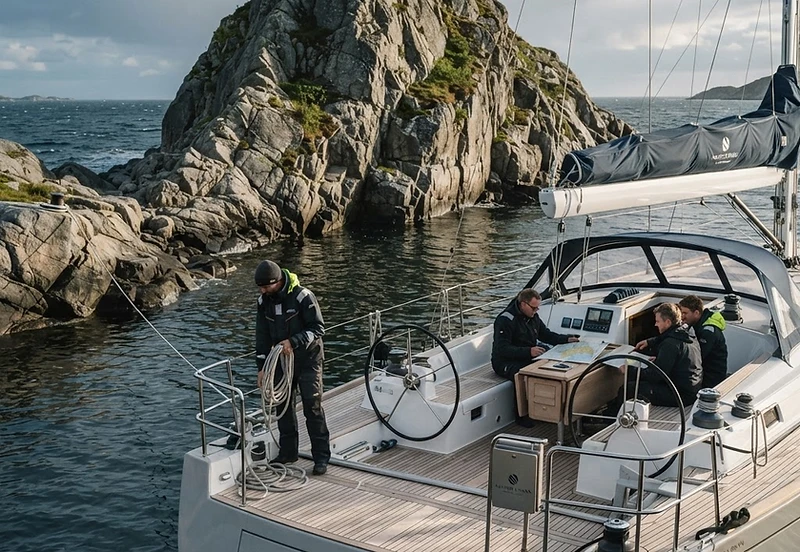
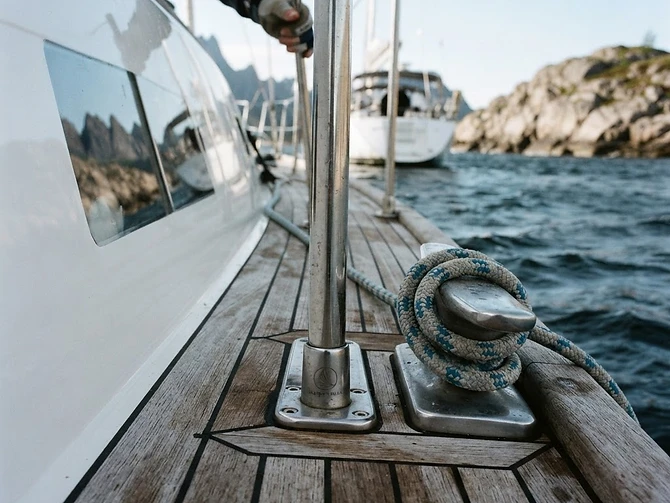
The North Atlantic does not merely exist; it commands. As we rounded the jagged, rain-shadowed profile of the Træna islands, the air turned crisp, tasting faintly of salt and ancient glaciers. Our vessel, a 78-foot Nautor’s Swan, sliced through the dark, obsidian-hued waters with a silent grace that only a finely tuned deck can provide. We had spent the morning navigating the intricate, labyrinthine channels of the Helgeland coast, tracing the topography of sea-drenched granite shelves that rise abruptly from the depths of the Norwegian Sea.
The Geometry of the Anchorage
Securing a position at anchor in these latitudes requires a particular reverence for the depth sounder. We found our stillness in a narrow bight protected by a crescent of wind-scoured stone. The water here was a profound, crystalline emerald, so clear that the movement of the anchor chain against the seafloor was visible from the teak-laid expanse of our aft deck. There is a distinct, rhythmic ritual to dropping anchor in the fjords: the heavy mechanical clatter of the winch, the sudden silence as the vessel finds its equilibrium, and the immediate transition into the calm that follows the exertion of the passage.
By two in the afternoon, the wind had shifted, channeling perfectly between the islands. It was the signal we had been anticipating. Deploying the tender, we ferried our kite-surfing gear toward a secluded patch of white-shell sand that seemed almost displaced from the tropics, were it not for the bracing, single-digit temperatures of the water. Preparing the kites on the narrow strip of beach, one becomes acutely aware of the environment; the wind does not just push against the fabric—it hums, a low-frequency vibration that reminds you of the immense energy churning through the North Sea.
The Rhythms of Life Aboard
Launching into the surf beneath the looming silhouettes of the Helgeland mountains provides a perspective on the yacht that is entirely unavailable from the helm. From the water, the Swan looked like a delicate, white needle pinned against the gargantuan scale of the Norwegian landscape. Returning to the yacht after an hour of carving through the choppy swells, the transition back to the deck is the true luxury of the day. The crew had already prepared the staging area: warm, oversized towels, a thermos of robust coffee, and a quiet, efficient readiness that marks the pinnacle of life at sea.
We spent the remainder of the evening in the saloon, the hull gently swaying to the residual swell. The transition from the high-energy exertion of the kite—the physical burn in the forearms and the sharp intake of cold, clean air—to the controlled, hushed environment of the interior is perhaps the most defining quality of modern yachting. Dinner was a simple, thoughtful affair: freshly caught arctic char, lightly seared, served alongside root vegetables grown in the short, intense summer of a nearby coastal settlement. The conversation drifted toward the next day’s heading, tracing the charts toward the Værøy archipelago, our voices barely rising above the low, hypnotic gurgle of the current against the rudder.
There is no pretense in these waters. The Helgeland coast demands a vessel that can handle the unpredictability of the North, but it rewards the voyager with an isolation that feels earned. As the twilight lingered, painting the granite peaks in bruised shades of violet and slate, the yacht felt not just like a platform for adventure, but a sanctuary—a piece of mobile architecture designed to exist in total harmony with the unforgiving beauty of the fjords.






