
The Obsidian Morning
The dawn watch off Isla Fernandina does not break with the soft, gilded pastels of the Mediterranean; it arrives in shades of charcoal, bruised violet, and the deep, unforgiving navy of the Pacific. Aboard our 45-meter expedition vessel, her hull geometry optimized with a plumb bow to shear through the relentless push of the Humboldt Current, the air is sharp, carrying the faint, metallic tang of raw volcanic basalt. This is the first charter of the season, a deliberate departure from the polished, social-heavy piers of the north. We have traded the predictable choreography of the marinas for an archipelago that remains in a state of perpetual geologic becoming. There is a profound, tectonic silence here, interrupted only by the rhythmic, percussive slap of cold water against the steel, and the distant, haunting bark of a Galápagos sea lion claiming a sun-scorched lava shelf as its own.
The Galley’s Pacific Dialogue
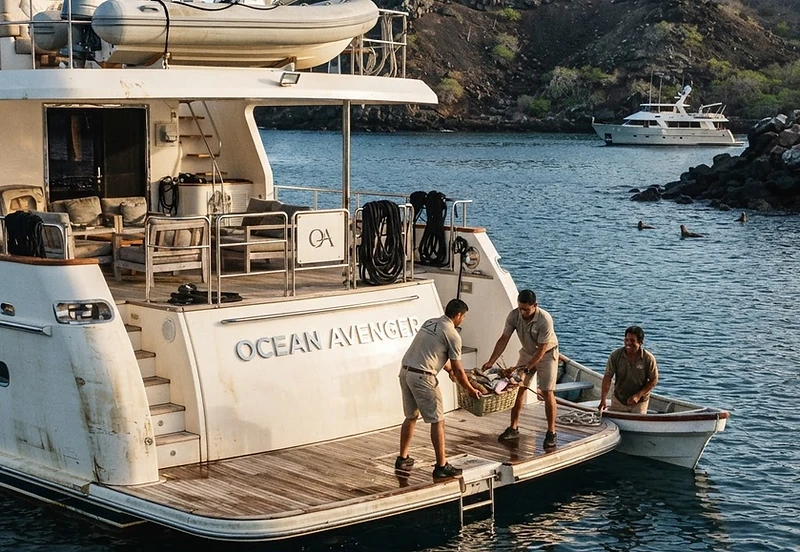
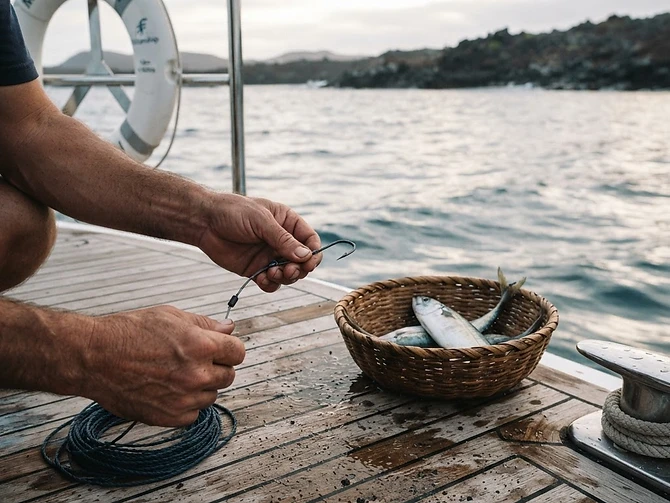
Life aboard is an exercise in responding to the archipelago’s singular ecology. The rhythm of our days is dictated by the currents and the early-morning radio traffic between our chef and the local fishermen at Puerto Ayora. The galley is not a place of global supply chains, but a laboratory of strict provenance. Our chef’s dialogue with the source is focused entirely on the morning’s yield: succulent langostinos, the prized Galápagos slipper lobster, and the firm, remarkably clean-fleshed wahoo. By noon, the aft deck transforms into a space for the translation of these ingredients. We dine on thin ribbons of wahoo, cured briefly in the bracing, high-acid punch of local lime and finished with a coarse, hand-harvested sea salt that retains the mineral-heavy tang of the deep trench offshore. There is no performative luxury in the presentation; the plate serves merely as a canvas for the brutal, beautiful biology of the islands. To eat here is to accept an invitation to participate in the cycle of the archipelago, understanding that every bite carries the weight of the water from which it was pulled.
The Anchorage at Post Office Bay
By late afternoon, the decision is made to drop the hook in the protected, glass-calm waters of Post Office Bay on Floreana Island. The custom tender is lowered—a nimble, carbon-fiber craft that allows us to thread through the craggy, uncharted shallows where our primary hull dare not venture. Stepping ashore, the latent heat of the ancient volcanic rock radiates through the soles of our deck shoes, a visceral, burning contrast to the chilled, nutrient-rich salinity of the water we have just departed. We convene at a modest, weathered table, far removed from the reach of global hospitality conglomerates, to share a meal of grilled octopus dressed in a light emulsion of local chili and plantains—a staple prepared with a rustic, ancestral intelligence. There is a singular, quiet honesty to the meal that no Michelin-starred terrace can replicate; it is a direct connection to the volcanic soil and the currents that have defined this place for centuries. As the sun dips behind the serrated horizon, casting long, reach-like shadows over the water, our yacht sits anchored in the bay—a solitary, luminous sentinel of white steel resting against the dark, eternal architecture of the volcanic coast.






