

The Anchor’s Logic
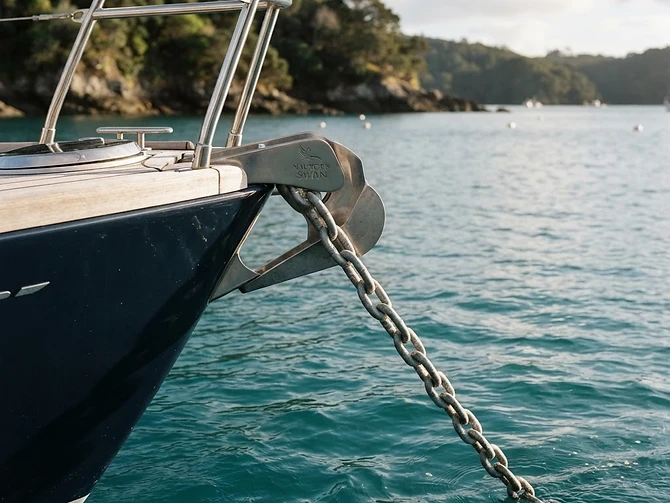
The Bay of Islands is not a place that rewards hurry. Here, among the scattered greens of the Moturua group and the sheltered reaches of Urupukapuka, the morning fog tends to linger, clinging to the teak-caulked deck of the Nautor’s Swan like wet silk. It was a Tuesday, the 29th of February, and the digital logs of our navigation suite displayed a date that the sea usually ignores. While the world of shore-based schedules scrambled to account for the phantom day, our existence aboard had dissolved into a different kind of tally. We were no longer counting calendar months; we were counting the swing of the chain and the cooling of the engine block.
Life at anchor dictates a recalibration of the senses. When you are static, your relationship with time becomes intimate and mechanical. On the chart table, the interplay between the vessel's movement and the terrestrial progression of the Gregorian calendar felt increasingly abstract. It is a peculiar sensation, sitting in the cockpit with a cup of strong coffee, watching the tide retreat from the jagged rocks, and realizing that the complex, hand-finished gearing of the Patek Philippe reference 5270 on my wrist was doing the heavy lifting that the rest of the world was struggling to reconcile.
Mechanical Cycles in the Lee of the Bay
To watch a perpetual calendar navigate the transition from February to March is to observe a miniature, crystalline engine of order. While the yacht strained gently against her mooring buoy, the watch’s movement—an architectural assembly of levers, springs, and cams—slipped silently past the 28th, refusing to acknowledge the need for a manual adjustment. There is a profound symmetry in this. A well-built vessel, much like a fine watch, is a closed system of stored energy and precision, designed to withstand the entropy of the open ocean. Whether one is monitoring the thermal drift of the cooling system or the rhythmic oscillation of a balance spring, the demand for absolute fidelity remains constant. The watch, ticking away in the humid, salt-thick air, acted as a silent partner to the vessel’s own structural integrity.
We spent the afternoon in the tender, exploring the narrow, sheltered inlets near the mainland. The water was glass, reflecting the dense, verdant kauri forests that line the shore. It was the sort of heavy silence that only exists when the wind drops completely, leaving the yacht a lone, gleaming sentry in a protected basin. Over a lunch of fresh snapper at a small, weathered quay near Opua, we discussed the human absurdity of the leap year. It is a necessary patch on a planetary misalignment—a stutter in the cosmic record. Yet, beneath the shade of the Norfolk pines, the watch on my wrist remained entirely indifferent to the chaos. It simply turned the wheel, engaged the leap-year cam, and moved on.
The Weight of the Zenith
As evening settled, the Southern Cross emerged with a clarity that seemed to sharpen the very air. The yacht shifted, turning her beam to the incoming tide, a move signaled by the slight, rhythmic creak of the anchor rode. In these hours, the distinction between the boat’s navigational systems and the mechanical complication of the watch thins. Both are instruments of orientation, one for the latitude and longitude of our journey, the other for the navigation of our duration.
Standing on the aft deck as the sun dipped behind the western headlands, the reality of the extra day vanished, absorbed into the dark, churning water. The watch had completed its task, its aperture now showing the first of March with the same clinical, beautiful silence with which it had navigated the dawn. It is a quiet luxury to exist in a space where time is measured not by the relentless demands of the clock, but by the slow, inevitable return of the tide. We sat on the stern, the only sound the rhythmic lapping of the Pacific against the hull, waiting for the moon to rise over the bay, content in the knowledge that everything—the yacht, the watch, and the sea—was in perfect, calculated alignment.






