
The Geometry of the Archipelago
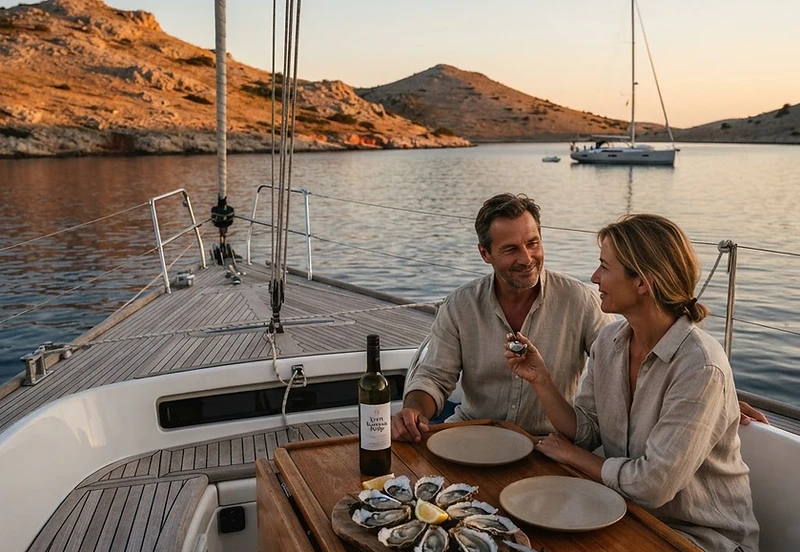
The Kornati archipelago does not merely occupy the Adriatic; it dominates the horizon with a chaotic, serrated geometry. Navigating this lunar landscape requires an intimate understanding of the bura winds that carve through the limestone channels, demanding a steady hand on the helm of a Nautor's Swan. As we maneuvered into the lee of a sheltered cove off Kornat, the deep-throated growl of the engine vanished, replaced by the rhythmic, hollow slap of Adriatic swells against the teak-clad hull. The anchor bite was solid, confirmed by the erratic, dance-like settling of our position on the plotter, and we felt the profound shift from the tension of the transit to the stillness of the anchorage. This is the authentic utility of the cruising life: the ability to command one's proximity to such ancient, silent geology while remaining entirely self-sufficient.
The Ritual of the Salted Shell
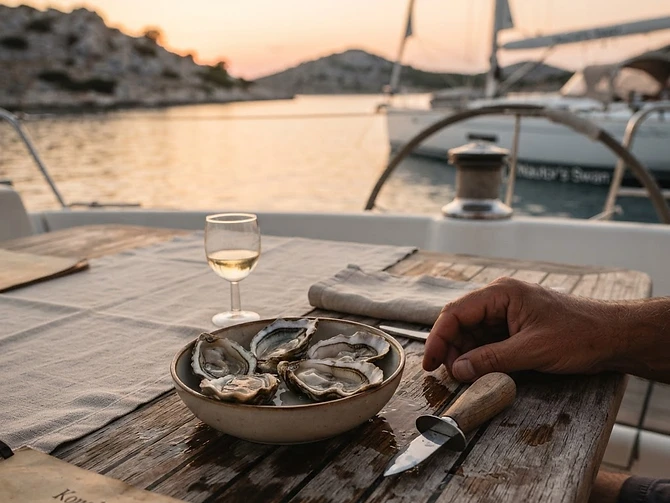
As the afternoon light softened into the bruised purples and apricots characteristic of a Dalmatian sunset, the crew lowered the hydraulic swim platform. It is a marvel of naval engineering—a mobile terrace suspended mere inches above the cooling sea—but in this quiet hour, its purpose shifts from transit to transcendence. Our chef, returning earlier that day from the vibrant, clamorous morning markets of Šibenik, presented a simple board of oysters sourced from the cold, nutrient-dense waters near Ston. These are not merely bivalves; they are a direct distillation of the Pelješac peninsula, delivering a bracing, mineral-heavy hit of salinity that speaks to the surrounding limestone karsts. We paired these with a glass of crisp, chilled Krug, the persistent, fine-beaded effervescence slicing through the rich, creamy texture of the oyster meat, anchoring the indulgence in the bracing reality of the salt-washed air.
The Alchemy of the Croatian Coast
Dining aboard in this region is a deliberate dialogue with the landscape. While the temptation to launch the tender for a passage to the stone-hewn tables of Konoba Opat—renowned for their slow-roasted peka prepared under iron bells—is always present, there is a singular, quiet logic to remaining at anchor. We chose to bring the provenance of the islands to us. The oysters were dressed with a vibrant Oblica olive oil, cold-pressed from trees that cling to the harsh, wind-swept hills of the neighboring islands, and finished with a delicate dusting of fleur de sel harvested from the historic salt pans of Nin. As we stood on the weathered teak, the horizon blurred, and the boundary between the vessel’s engineered precision and the raw, rugged architecture of the archipelago dissolved entirely.
The sun eventually slipped behind the jagged limestone ridge, casting the water into the deep, metallic hue of hammered pewter. The conversation ebbed, leaving us to listen to the distant, haunting cry of a gull and the metallic, rhythmic clink of a crystal flute against the swim platform’s stainless-steel railing. The day, like the tide, had reached its natural conclusion, leaving us suspended in the deepening blue, entirely at home in the vast, ancient quiet of the Adriatic.






